Bio4Energy

  • Research
    • Platforms
    • Strategic Funds & Projects
    • Publications
  • Context
    • Global Challenges
    • Biomass Resources
    • Biorefineries
  • Education
    • Bio4Energy Graduate School
    • PhD Projects
    • Alumni
    • Undergraduate Education
  • Collaboration
    • Research Collaboration
    • Bio4Energy Advisory Board
  • About Us
    • Bio4Energy — A Strategic Research Environment
    • Contact
    • Open Positions
    • Download Materials
  • News & Events
    • Bio4Energy Calendar
  • Click to open the search input field Click to open the search input field Search
  • Menu Menu
Home1 / PhD defence

The Hidden Conversation Between Trees and Nitrogen

10 December, 2025/in News, PhD defence/by Irina Iakovleva
Anna Renström preparing materials and equipment for the hybrid aspen experiment carried out by Prof. Hannele Tuominen’s group.
Anna Renström preparing materials and equipment for the hybrid aspen experiment . Photo by Hannele Tuominen

Before a tree reaches for the sky, its story forms quietly within the wood. There, nitrogen acts as a subtle signal that guides growth and change. Through her research, Anna Renström uncovers this hidden dialogue and reveals how developing wood senses and responds to the nutrients shaping it.

In ancient Eastern wisdom, it is said that a vessel is defined not by how much it can hold but by the balance it keeps. Too little leaves it empty, too much makes it overflow. Forests live by a similar quiet rule. Among all the elements that shape a tree’s growth, nitrogen carries a subtle but decisive influence, essential for life yet disruptive when its balance is lost.

For many years, scientists around the world have studied nitrogen and its effects on forest growth. We know that it can encourage trees to grow faster, and we also know that excessive fertilisation can unsettle entire ecosystems. But one part of the story has remained less visible: what happens inside the wood itself when nitrogen reaches it? How do the young cells that form the tree’s stem respond to different forms and amounts of this nutrient?

“To understand forest growth, we must first understand how a single cell listens.”

This idea stands at the heart of Anna Renström’s research. Working with hybrid aspen, she varied both the form and the level of nitrogen the trees received, giving them different kinds of nutritional cues. Using near-infrainfrared hyperspectral imaging, she looked into the wood and followed its density, chemistry and structure as they quietly shifted.
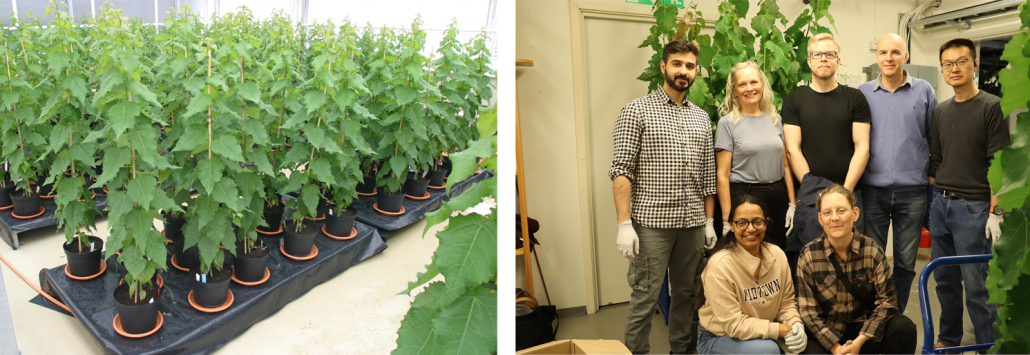
Hybrid aspen plants grown in the greenhouse as part of the experimental setup (left). Members of Prof. Hannele Tuominen’s research group (right). Photo by Hannele Tuominen

A pattern slowly emerged. With higher nitrogen availability, the trees grew taller and thicker, their xylem cells expanded and their stems accumulated more biomass. Yet the wood itself changed. It became lighter, its lignin content decreased, and its chemical profile shifted. Among the nitrogen forms, nitrate behaved differently from the rest. It promoted shoot growth, increased the proportion of H-type lignin and left a distinct signature in the developing xylem.

Even more striking was nitrate’s role as a signal. It travelled upward with the xylem sap and entered the developing wood, where it rapidly activated genes associated with cell expansion. Through a molecular regulator called CRF4, nitrate helped initiate the early steps of radial growth, revealing a signalling mechanism not previously described in trees.

But the story also carried a note of caution. When developing xylem cells absorbed too much nitrate, growth slowed instead of accelerating. Even essential nourishment can become a burden when balance is lost.

“Fertilisation should not be force, it should be precision.”

Anna’s work stands within a long tradition of nitrogen research while adding something genuinely new. It offers a molecular and anatomical understanding of how developing wood perceives and responds to nitrogen. And it points toward a future in which forest fertilisation becomes a careful and informed practice rather than a uniform recipe, a way of working with the forest rather than against its natural rhythms.

On December 15, this thoughtful exploration will culminate as Anna Renström defends her doctoral thesis, a work that turns silent processes inside sap, cells and fibres into knowledge that can support more sustainable and balanced forest management.

https://bio4energy.se/wp-content/uploads/2025/12/Anna-Renstrom-2-3.png 620 779 Irina Iakovleva https://bio4energy.se/wp-content/uploads/2022/08/Logo_stor_farg-300x74.png Irina Iakovleva2025-12-10 15:16:102025-12-11 10:32:05The Hidden Conversation Between Trees and Nitrogen

From Wood to Wonder – Turning wood into advanced materials

15 November, 2025/in News, PhD defence, Publication/by Irina Iakovleva

For centuries, we’ve known how to make paper from wood.
Who would have imagined that one day it could help heal wounds?
Science keeps pushing boundaries and makes the impossible possible.

Cellulose, in particular, is nature’s quiet masterpiece: a strong, fibrous network that gives trees their strength and shape. These structures work together, forming the tall forests that breathe life into our planet. Now imagine being able to gently rearrange that internal structure of wood and guide it into new forms. With a careful touch of chemistry, this transformation becomes possible. One of the most effective ways to achieve this is through a process called TEMPO oxidation, which allows scientists to open up the cellulose fibers and reveal the hidden layers within wood. Its structure separates into nanocellulose, threads thousands of times thinner than a human hair, yet remarkably strong. From these, new materials can be formed: light, transparent, and flexible sheets, known as nanocellulose films, that still carry the essence of their natural origin.

But to reach this stage, wood must first go through a long journey: stripped, pulped, bleached, and refined before it can be transformed into nanocellulose. PhD student Yagmur Bas asked a simple but daring question: What if we could skip all that?

“I wanted to see how far we could go using the wood in its natural, unprocessed form,” Yagmur explains. “Could it still develop into a nanocellulose network, without all the usual processing?”

To find out, she began working with wood particles from different species, exposing them to the same TEMPO-oxidation process normally used for refined pulp. She compared these raw particles with never-dried and commercial TEMPO-oxidized pulps, watching how each material changed as the fibers unfolded and reformed into delicate networks. Some woods opened more readily and carried more charge; others formed denser, tougher structures. These side-by-side experiments offered a rare glimpse into how both the origin of the tree and the way the material had been processed shaped the chemistry and the nature of the final film.

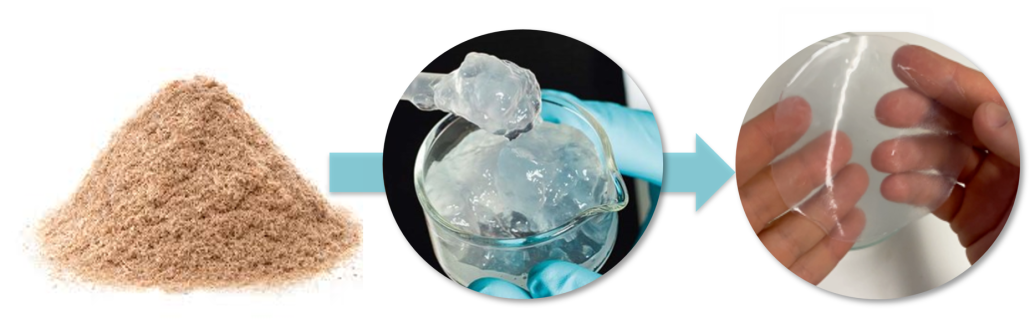
From wood particles to nanocellulose-based wound dressing: starting material in the form of wood particles (left), TEMPO-oxidized cellulose nanofiber gel (middle), and the same gel after vacuum-assisted filtration, forming a self-assembled nanofiber network/hydrogel. Foto: Per Bäckström

The result was a material with a character of its own. The nanocellulose networks formed from TEMPO-oxidized wood turned out to be remarkably stable and adaptable. They absorb in large amounts of liquid while staying intact, their fine structure holding together even when fully swollen. This balance between softness and strength made them ideal for for contact with living tissue: gentle to skin, yet mechanically reliable.

Working closely with her supervisor, Linn Berglund, Yagmur began shaping these films into materials that could serve real functions, particularly for wound healing. Together with biochemical collaborators, they looked for ways to integrate bioactive compounds, such as “healing peptides”, into the cellulose network, allowing the film not just to protect but to actively support recovery.

The transparency of the films added another dimension. Light could pass through the thin, wood-derived film, revealing what lay beneath, a property that would soon capture attention far beyond the laboratory.

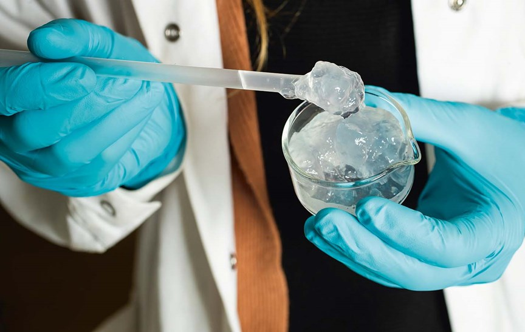
Nanocellulosa gel/cellulose nanofiber gel after TEMPO-oxidation and fibrillation.
Foto: Per Bäckström

“As soon as they saw it, the nurses focused on the transparency,” recalls Linn Berglund. “Being able to check a wound without taking off the dressing is a clear clinical advantage.”

Beyond the biomedical field, the films also showed potential for electrochemical applications, demonstrating stability and ion transport properties relevant for energy storage systems.

What began as a materials study had quietly grown into something more, a collaboration that shaped both the material and the people behind it. For Yagmur Bas, it became a foundation to build on, and the next step of that journey will unfold at her upcoming public defense.

Yagmur Bas will publicly defend her doctoral thesis, From Wood to Advanced Materials: Multifunctional TEMPO-Oxidized Wood Nanofibril Networks as Wound Dressings and Energy Storage Device Separators at Luleå University of Technology, on 20 November 2025 at 10:00.

https://bio4energy.se/wp-content/uploads/2025/11/Pic-1-1.png 349 855 Irina Iakovleva https://bio4energy.se/wp-content/uploads/2022/08/Logo_stor_farg-300x74.png Irina Iakovleva2025-11-15 19:09:132025-11-15 20:11:37From Wood to Wonder – Turning wood into advanced materials

Pages

  • About Us
  • Bio4Energy — A Strategic Research Environment
  • Bio4Energy Calendar
  • Collaboration
  • Context
  • Education
  • Home
  • Investigating the electrochemical functionality of Norway spruce bark biochar and polymer composites
  • News & Events
  • Newsletter
  • Research
  • Bio4Energy Graduate School
  • Contact
  • Global Challenges
  • P1 Systems Analysis and Bioeconomy
  • Platforms
  • Research Collaboration
  • Bio4Energy Advisory Board
  • Biomass Resources
  • Open Positions
  • P2 Forest-based Feedstocks
  • PhD Projects
  • Strategic Funds & Projects
  • Alumni
  • Biorefineries
  • Download Materials
  • P3 Feedstock Pre-processing
  • Publications
  • P4 Thermochemical Conversion
  • Undergraduate Education
  • P5 Biopolymers and Biochemical Conversion
  • P6 Catalysis and Separation
  • P7 Environment and Nutrient Recycling

Categories

  • News
  • PhD defence
  • Platform
  • Publication
  • Uncategorized

Archive

  • February 2026
  • December 2025
  • November 2025
  • October 2025
  • September 2025
  • June 2025
  • May 2025
  • March 2025
  • December 2024
  • November 2024
  • October 2024
  • September 2024
  • August 2024
  • July 2024
  • June 2024
  • April 2024
  • March 2024
  • February 2024
  • January 2024
  • December 2023
  • November 2023
  • October 2023
  • September 2023
  • August 2023
  • July 2023
  • June 2023
  • May 2023
  • April 2023
  • March 2023
  • February 2023
  • January 2023
  • December 2022
  • November 2022
  • October 2022
  • September 2022
  • August 2022
  • June 2022
  • April 2022
  • March 2022
  • February 2022
  • January 2022
  • January 2021
  • January 2020
  • January 2019
  • November 2018
  • January 2018
  • January 2017
  • January 2016
  • January 2015
  • January 2014
  • January 2013
  • January 2012
  • January 2011
  • January 2010

VISITING ADDRESS

Umeå University Campus Map

ADDRESS

Bio4Energy

Umeå University

SE-90187 UMEÅ

Sweden

LOG IN

Scroll to top Scroll to top Scroll to top