Bio4Energy

  • Research
    • Platforms
    • Strategic Funds & Projects
    • Publications
  • Context
    • Global Challenges
    • Biomass Resources
    • Biorefineries
  • Education
    • Bio4Energy Graduate School
    • PhD Projects
    • Alumni
    • Undergraduate Education
  • Collaboration
    • Research Collaboration
    • Bio4Energy Advisory Board
  • About Us
    • Bio4Energy — A Strategic Research Environment
    • Contact
    • Open Positions
    • Download Materials
  • News & Events
    • Bio4Energy Calendar
  • Click to open the search input field Click to open the search input field Search
  • Menu Menu
Home1 / News2 / The Hidden Conversation Between Trees and Nitrogen

The Hidden Conversation Between Trees and Nitrogen

10 December, 2025/in News, PhD defence/by Irina Iakovleva
Anna Renström preparing materials and equipment for the hybrid aspen experiment carried out by Prof. Hannele Tuominen’s group.
Anna Renström preparing materials and equipment for the hybrid aspen experiment . Photo by Hannele Tuominen

Before a tree reaches for the sky, its story forms quietly within the wood. There, nitrogen acts as a subtle signal that guides growth and change. Through her research, Anna Renström uncovers this hidden dialogue and reveals how developing wood senses and responds to the nutrients shaping it.

In ancient Eastern wisdom, it is said that a vessel is defined not by how much it can hold but by the balance it keeps. Too little leaves it empty, too much makes it overflow. Forests live by a similar quiet rule. Among all the elements that shape a tree’s growth, nitrogen carries a subtle but decisive influence, essential for life yet disruptive when its balance is lost.

For many years, scientists around the world have studied nitrogen and its effects on forest growth. We know that it can encourage trees to grow faster, and we also know that excessive fertilisation can unsettle entire ecosystems. But one part of the story has remained less visible: what happens inside the wood itself when nitrogen reaches it? How do the young cells that form the tree’s stem respond to different forms and amounts of this nutrient?

“To understand forest growth, we must first understand how a single cell listens.”

This idea stands at the heart of Anna Renström’s research. Working with hybrid aspen, she varied both the form and the level of nitrogen the trees received, giving them different kinds of nutritional cues. Using near-infrainfrared hyperspectral imaging, she looked into the wood and followed its density, chemistry and structure as they quietly shifted.
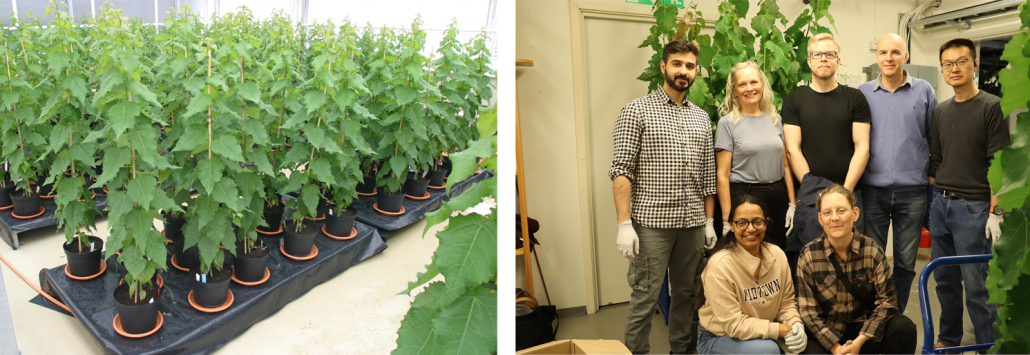
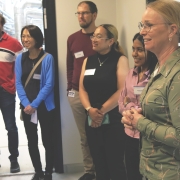
Hybrid aspen plants grown in the greenhouse as part of the experimental setup (left). Members of Prof. Hannele Tuominen’s research group (right). Photo by Hannele Tuominen

A pattern slowly emerged. With higher nitrogen availability, the trees grew taller and thicker, their xylem cells expanded and their stems accumulated more biomass. Yet the wood itself changed. It became lighter, its lignin content decreased, and its chemical profile shifted. Among the nitrogen forms, nitrate behaved differently from the rest. It promoted shoot growth, increased the proportion of H-type lignin and left a distinct signature in the developing xylem.

Even more striking was nitrate’s role as a signal. It travelled upward with the xylem sap and entered the developing wood, where it rapidly activated genes associated with cell expansion. Through a molecular regulator called CRF4, nitrate helped initiate the early steps of radial growth, revealing a signalling mechanism not previously described in trees.

But the story also carried a note of caution. When developing xylem cells absorbed too much nitrate, growth slowed instead of accelerating. Even essential nourishment can become a burden when balance is lost.

“Fertilisation should not be force, it should be precision.”

Anna’s work stands within a long tradition of nitrogen research while adding something genuinely new. It offers a molecular and anatomical understanding of how developing wood perceives and responds to nitrogen. And it points toward a future in which forest fertilisation becomes a careful and informed practice rather than a uniform recipe, a way of working with the forest rather than against its natural rhythms.

On December 15, this thoughtful exploration will culminate as Anna Renström defends her doctoral thesis, a work that turns silent processes inside sap, cells and fibres into knowledge that can support more sustainable and balanced forest management.
Tags: Anna Renström, Bio4Energy, Fertilisation, Forest, hybrid aspen, Nitrogen, PhD defence, Research and development, Swedish University of Agricultural Sciences, Umeå University
https://bio4energy.se/wp-content/uploads/2025/12/Anna-Renstrom-2-3.png 620 779 Irina Iakovleva https://bio4energy.se/wp-content/uploads/2022/08/Logo_stor_farg-300x74.png Irina Iakovleva2025-12-10 15:16:102025-12-11 10:32:05The Hidden Conversation Between Trees and Nitrogen
You might also like
Plant scientist Rosario García-Gil received a "medal" for her contribution to science and collaborations. Photo by courtesy of Rosario Garcìa-Gil. Bio4Energy Researcher Awarded Medal for ‘Exceptional Contribution’
Biomass (left) must be turned into biocarbon (right) in a controlled process to be an alternative for use to fossil coal in the iron and steel industries. Kentaro Umeki is Bio4Energy's man on the job. Photos by courtesy of Kentaro Umeki, Luleå University of Technology.Courtesy Kentaro Umeki. Collage by Anna Strom Phase Out of Fossil Coal in Sweden’s Iron, Steel Industries on Cards
Trees play a vital role in maintaining the health of our planet and supporting human life in various ways. To use them as an economic resource, we advocate finding ways that will sustain both us and nature. Photo by AnnaStrom ©2024.©AnnaStrom Bio4Energy 2023: Full Steam Ahead in Education, Research, Forming Collaborations
Fakta RISE pilothall i Örnsköldsvik • 3 våningar • 2 405 m2 • 14 meter hög • Miljöbyggnad Silver (Sweden Green Building Council) • Stora delar byggt i korslimmat trä • Komfort- och proceskyla hämtas från Örnsköldsviksfjärdens botten • Sedumtak (hjälper vattenavrinning och biodiversitet)RISE Giant Park for Development of Bio-based Products, Materials, Opens in Northern Sweden
Bio4Energy September Start for Bio4Energy’s Training to Scale up Bio-based Innovations
Traditionally, Bio4Energy has been targeting wood from conifers in its research. Photo by Anna Strom ©2023.©AnnaStrom Bio4Energy is Delivering Methods, Tools to Industry as Promised
Ulrika Rova, Luleå University of Technology, is new coordinator for Bio4Energy's membership in BioInnovation, Swedish funder. Photo by courtesy of Ulrika Rova.Bio4Energy Seeing Possibilities: Meet Bio4Energy’s Coordinator for Swedish funder BioInnovation
A model of the Vertisà AB vertical gardening module. Photo by courtesy of Vertisà AB. Inventions by Bio4Energy Researchers Highlighted by Royal Academy for Future Potential

Latest news

  • Bio4energy Advisory bord meeting (digital)
    Bio4Energy Advisory Board meeting – EU perspectives on the bioeconomy and bio-based resources23 February, 2026 - 11:38
  • The Hidden Conversation Between Trees and Nitrogen10 December, 2025 - 15:16
  • From Wood to Wonder – Turning wood into advanced materials15 November, 2025 - 19:09

VISITING ADDRESS

Umeå University Campus Map

ADDRESS

Bio4Energy

Umeå University

SE-90187 UMEÅ

Sweden

LOG IN

Link to: From Wood to Wonder – Turning wood into advanced materials Link to: From Wood to Wonder – Turning wood into advanced materials From Wood to Wonder – Turning wood into advanced materials Link to: Bio4Energy Advisory Board meeting – EU perspectives on the bioeconomy and bio-based resources Link to: Bio4Energy Advisory Board meeting – EU perspectives on the bioeconomy and bio-based resources Bio4energy Advisory bord meeting (digital)Bio4Energy Advisory Board meeting – EU perspectives on the bioeconomy and...
Scroll to top Scroll to top Scroll to top