
Bio4Energy

  • Research
    • Platforms
    • Strategic Funds & Projects
    • Publications
  • Context
    • Global Challenges
    • Biomass Resources
    • Biorefineries
  • Education
    • Bio4Energy Graduate School
    • PhD Projects
    • Alumni
    • Undergraduate Education
  • Collaboration
    • Research Collaboration
    • Bio4Energy Advisory Board
  • About Us
    • Bio4Energy — A Strategic Research Environment
    • Contact
    • Open Positions
    • Download Materials
  • News & Events
    • Bio4Energy Calendar
  • Click to open the search input field Click to open the search input field Search
  • Menu Menu
Home1 / February
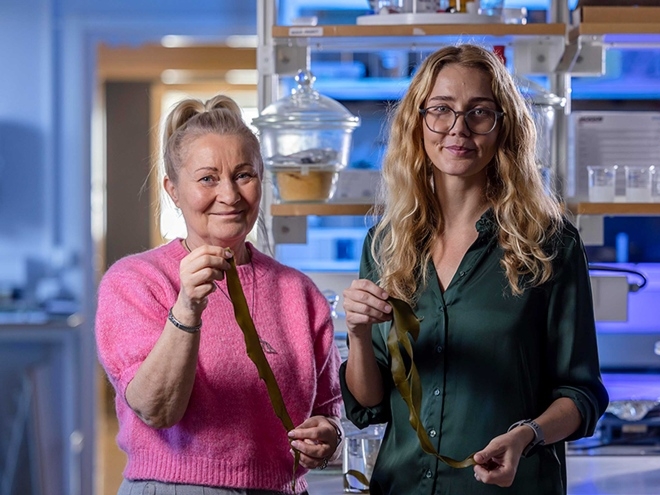
Bio4Energy scientists Kristiina Oksman (left) and Linn Berglund are showing slivers of the brown kelp used as input material, at their research laboratory.LTU

Breakthrough Innovation: Hydrogels from Norwegian Kelp to Be Commercialised

13 February, 2023/in News/by Anna Strom

Bio4Energy researchers are behind a breakthrough innovation that can be used to make bio-based and biodegradable hydrogels.

Hydrogels are key components in materials used to restore or maintain human health such as wound healing, tissue engineering, artificial organs or everyday contact lenses.

The ingenuity of hydrogels lies in a dichotomy: While they are able to absorb and hold water, they do not decompose as a result.

However, as much as hydrogels are an indispensable part of modern medicine, today only synthetic hydrogels of the kind desired are available on the market and they are resource-intensive to produce, according to an article at the website of Luleå University of Technology, where the Bio4Energy researchers work.

Applying nanotechnology to brown algae grown in Norwegian waters, scientists Kristiina Oksman and Linn Berglund were able to skip steps that are paramount to making hydrogels of the synthetic kind. This means that the new bio-based technology requires less energy at production and generates less waste.

Nano-scale processing of the starting material also means that good quality hydrogel can be ascertained, as the cellulose is separated into ultra-small fibres and desirable qualities of the alginate salts are retained.

Alginor ASA, a Norwegian firm, has bought the resulting patent and are constructing a processing plant for this type of brown kelp, Laminaria Hyperborea.

“Alginor ASA wants to use the method to make full use of the harvest of Laminaria Hyperborea, or brown kelp, a species that is common in Norwegian waters”, professor Oksman said.

Contacts

Linn Berglund – Bio4Energy Biopolymers and Biochemical Conversion, affiliation with Luleå University of Technology

Kristiina Oksman – Bio4Energy Biopolymers and Biochemical Conversion, affiliation with Luleå University of Technology

Scientific article

No scientific literature has been disclosed.

Examples of Bio4Energy projects involving similar technologies can be found here:

  • Development of energy-efficient processing technology of wood biomass into nanofibres and biocomposites through the use of fungal pre-treated substrates, accessing the sustainability goals
  • Utilising the natural composition of bio-based residues for efficient separation of functional nanofibres
https://bio4energy.se/wp-content/uploads/2023/02/LTU-Alger_71_sma_webb2-e1676308421209.jpg 495 660 Anna Strom https://bio4energy.se/wp-content/uploads/2022/08/Logo_stor_farg-300x74.png Anna Strom2023-02-13 17:22:542024-10-23 14:39:43Breakthrough Innovation: Hydrogels from Norwegian Kelp to Be Commercialised

Pages

  • About Us
  • Bio4Energy — A Strategic Research Environment
  • Bio4Energy Calendar
  • Collaboration
  • Context
  • Education
  • Home
  • Investigating the electrochemical functionality of Norway spruce bark biochar and polymer composites
  • News & Events
  • Newsletter
  • Research
  • Bio4Energy Graduate School
  • Contact
  • Global Challenges
  • P1 Systems Analysis and Bioeconomy
  • Platforms
  • Research Collaboration
  • Bio4Energy Advisory Board
  • Biomass Resources
  • Open Positions
  • P2 Forest-based Feedstocks
  • PhD Projects
  • Strategic Funds & Projects
  • Alumni
  • Biorefineries
  • Download Materials
  • P3 Feedstock Pre-processing
  • Publications
  • P4 Thermochemical Conversion
  • Undergraduate Education
  • P5 Biopolymers and Biochemical Conversion
  • P6 Catalysis and Separation
  • P7 Environment and Nutrient Recycling

Categories

  • News
  • PhD defence
  • Platform
  • Publication
  • Uncategorized

Archive

  • February 2026
  • December 2025
  • November 2025
  • October 2025
  • September 2025
  • June 2025
  • May 2025
  • March 2025
  • December 2024
  • November 2024
  • October 2024
  • September 2024
  • August 2024
  • July 2024
  • June 2024
  • April 2024
  • March 2024
  • February 2024
  • January 2024
  • December 2023
  • November 2023
  • October 2023
  • September 2023
  • August 2023
  • July 2023
  • June 2023
  • May 2023
  • April 2023
  • March 2023
  • February 2023
  • January 2023
  • December 2022
  • November 2022
  • October 2022
  • September 2022
  • August 2022
  • June 2022
  • April 2022
  • March 2022
  • February 2022
  • January 2022
  • January 2021
  • January 2020
  • January 2019
  • November 2018
  • January 2018
  • January 2017
  • January 2016
  • January 2015
  • January 2014
  • January 2013
  • January 2012
  • January 2011
  • January 2010

VISITING ADDRESS

Umeå University Campus Map

ADDRESS

Bio4Energy

Umeå University

SE-90187 UMEÅ

Sweden

LOG IN

Scroll to top Scroll to top Scroll to top