
Bio4Energy

  • Research
    • Platforms
    • Strategic Funds & Projects
    • Publications
  • Context
    • Global Challenges
    • Biomass Resources
    • Biorefineries
  • Education
    • Bio4Energy Graduate School
    • PhD Projects
    • Alumni
    • Undergraduate Education
  • Collaboration
    • Research Collaboration
    • Bio4Energy Advisory Board
  • About Us
    • Bio4Energy — A Strategic Research Environment
    • Contact
    • Open Positions
    • Download Materials
  • News & Events
    • Bio4Energy Calendar
  • Click to open the search input field Click to open the search input field Search
  • Menu Menu
Home1 / November
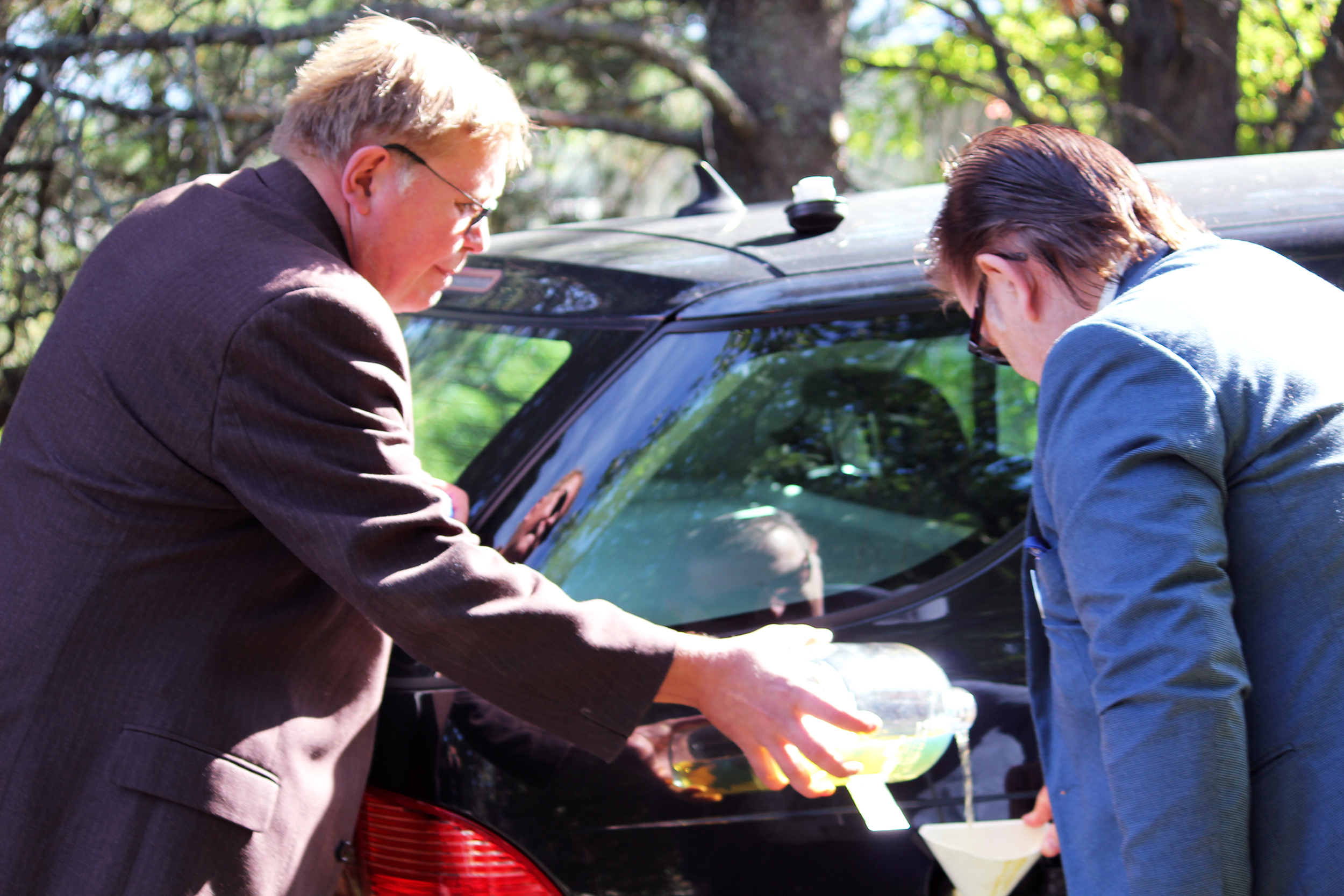
Fuelling with entirely bio-based petrol. Jyri-Pekka Mikkola (left) and Kent van Klint. Photo by ©AnnaStrom.©AnnaStrom

Entirely “green” petrol, diesel, jet fuel being developed in Sweden

23 November, 2018/in News/by Anna Strom

Bio4Energy researchers at Umeå University and partnering company Eco Oil Sweden have launched a new technology for making “green” equivalents of fossil fuels petrol, diesel and kerosene (jet fuel).

The new fuels contain not a single fossil molecule but still may be used in conventional automotive engines, thanks to their being chemical equivalents. The production process can be operated by non-experts within the space of a standard shipping container.

The new fuels contain not a single fossil molecule but still may be used in conventional automotive engines, thanks to their being chemical equivalents. The production process can be operated by non-experts within the space of a standard shipping container.

The technology and the pilot unit that it has been tested in have already attracted the attention of investors in Sweden, Germany, the United Arab Emirates and the United States.

“The containers can be shipped anywhere in the world”, said lead researcher Jyri-Pekka Mikkola, Professor at Umeå University and Åbo Akademi University, in Sweden and Finland, respectively.

Hydrocarbons are the basic components of fossil fuels such as petrol, diesel and jet fuel. It follows that making hydrocarbons from biomass, for instance forestry residues, has been a hot topic in research and development.

Disruptive technology

“This is a disruptive technology. It does not have to be constructed on the scale of a biorefinery”, Mikkola said.

“This application could be operated on behalf of a petrol station or village. Because the process also renders liquefied petroleum gas, which can be used in gas-to-power engines, it may be used to produce electricity”, he added.

The pilot unit that the technology has been tested in can make up to 250 litres of biofuel per day from biomass that is turned into an alcohol before becoming hydrocarbons.

The researchers together with business partner Kent van Klint have started a company, Eco Oil Sweden; to market the technology. The next step for the business partners is to demonstrate the technology on a near commercial scale.

Two full-scale plants on cards

“Two full-scale plants will be built. One for petrol and one for diesel, according to the principle that the resulting fuels will be entirely void of petrochemicals. Both fuels will be exact chemical copies of their synthetic counterparts,” according to van Klint.

“Our business model is to produce and sell plants”, he said.

“We leave it in the hands of those who have capital to construct full-scale production units”, Mikkola added.

“We are going to concentrate on selling licences and making the catalysts. The secret is in the catalysts”.

The invention and the pilot unit have been developed by Mikkola and colleagues Ajaikumar Samikannu, William Siljebo and Lakhya Konwar in the research environment Bio4Energy at Umeå University in northern Sweden.

The group members are partners in the company Eco Oil Sweden.

https://bio4energy.se/wp-content/uploads/2018/11/Green-petrol-fuelling_AnnaStrom©2024.jpg 1667 2500 Anna Strom https://bio4energy.se/wp-content/uploads/2022/08/Logo_stor_farg-300x74.png Anna Strom2018-11-23 18:06:002024-10-17 14:30:10Entirely “green” petrol, diesel, jet fuel being developed in Sweden

Pages

  • About Us
  • Bio4Energy — A Strategic Research Environment
  • Bio4Energy Calendar
  • Collaboration
  • Context
  • Education
  • Home
  • Investigating the electrochemical functionality of Norway spruce bark biochar and polymer composites
  • News & Events
  • Newsletter
  • Research
  • Bio4Energy Graduate School
  • Contact
  • Global Challenges
  • P1 Systems Analysis and Bioeconomy
  • Platforms
  • Research Collaboration
  • Bio4Energy Advisory Board
  • Biomass Resources
  • Open Positions
  • P2 Forest-based Feedstocks
  • PhD Projects
  • Strategic Funds & Projects
  • Alumni
  • Biorefineries
  • Download Materials
  • P3 Feedstock Pre-processing
  • Publications
  • P4 Thermochemical Conversion
  • Undergraduate Education
  • P5 Biopolymers and Biochemical Conversion
  • P6 Catalysis and Separation
  • P7 Environment and Nutrient Recycling

Categories

  • News
  • PhD defence
  • Platform
  • Publication
  • Uncategorized

Archive

  • February 2026
  • December 2025
  • November 2025
  • October 2025
  • September 2025
  • June 2025
  • May 2025
  • March 2025
  • December 2024
  • November 2024
  • October 2024
  • September 2024
  • August 2024
  • July 2024
  • June 2024
  • April 2024
  • March 2024
  • February 2024
  • January 2024
  • December 2023
  • November 2023
  • October 2023
  • September 2023
  • August 2023
  • July 2023
  • June 2023
  • May 2023
  • April 2023
  • March 2023
  • February 2023
  • January 2023
  • December 2022
  • November 2022
  • October 2022
  • September 2022
  • August 2022
  • June 2022
  • April 2022
  • March 2022
  • February 2022
  • January 2022
  • January 2021
  • January 2020
  • January 2019
  • November 2018
  • January 2018
  • January 2017
  • January 2016
  • January 2015
  • January 2014
  • January 2013
  • January 2012
  • January 2011
  • January 2010

VISITING ADDRESS

Umeå University Campus Map

ADDRESS

Bio4Energy

Umeå University

SE-90187 UMEÅ

Sweden

LOG IN

Scroll to top Scroll to top Scroll to top