

The Hidden Conversation Between Trees and Nitrogen

Before a tree reaches for the sky, its story forms quietly within the wood. There, nitrogen acts as a subtle signal that guides growth and change. Through her research, Anna Renström uncovers this hidden dialogue and reveals how developing wood senses and responds to the nutrients shaping it.
In ancient Eastern wisdom, it is said that a vessel is defined not by how much it can hold but by the balance it keeps. Too little leaves it empty, too much makes it overflow. Forests live by a similar quiet rule. Among all the elements that shape a tree’s growth, nitrogen carries a subtle but decisive influence, essential for life yet disruptive when its balance is lost.
For many years, scientists around the world have studied nitrogen and its effects on forest growth. We know that it can encourage trees to grow faster, and we also know that excessive fertilisation can unsettle entire ecosystems. But one part of the story has remained less visible: what happens inside the wood itself when nitrogen reaches it? How do the young cells that form the tree’s stem respond to different forms and amounts of this nutrient?
“To understand forest growth, we must first understand how a single cell listens.”
This idea stands at the heart of Anna Renström’s research. Working with hybrid aspen, she varied both the form and the level of nitrogen the trees received, giving them different kinds of nutritional cues. Using near-infrainfrared hyperspectral imaging, she looked into the wood and followed its density, chemistry and structure as they quietly shifted.
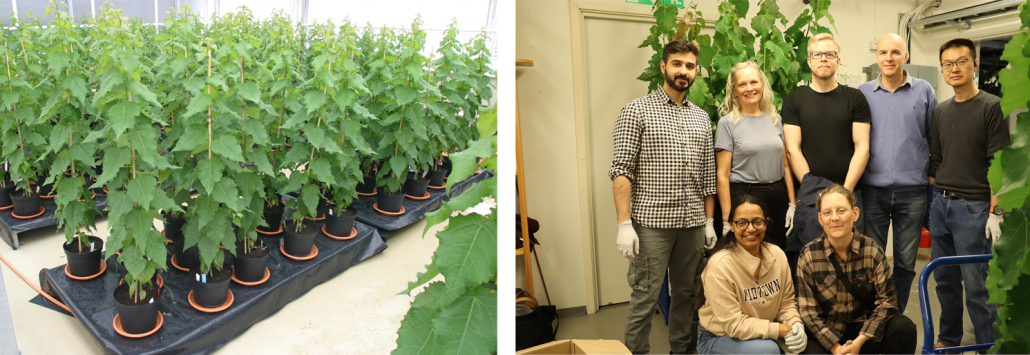
A pattern slowly emerged. With higher nitrogen availability, the trees grew taller and thicker, their xylem cells expanded and their stems accumulated more biomass. Yet the wood itself changed. It became lighter, its lignin content decreased, and its chemical profile shifted. Among the nitrogen forms, nitrate behaved differently from the rest. It promoted shoot growth, increased the proportion of H-type lignin and left a distinct signature in the developing xylem.
Even more striking was nitrate’s role as a signal. It travelled upward with the xylem sap and entered the developing wood, where it rapidly activated genes associated with cell expansion. Through a molecular regulator called CRF4, nitrate helped initiate the early steps of radial growth, revealing a signalling mechanism not previously described in trees.
But the story also carried a note of caution. When developing xylem cells absorbed too much nitrate, growth slowed instead of accelerating. Even essential nourishment can become a burden when balance is lost.
“Fertilisation should not be force, it should be precision.”
Anna’s work stands within a long tradition of nitrogen research while adding something genuinely new. It offers a molecular and anatomical understanding of how developing wood perceives and responds to nitrogen. And it points toward a future in which forest fertilisation becomes a careful and informed practice rather than a uniform recipe, a way of working with the forest rather than against its natural rhythms.
On December 15, this thoughtful exploration will culminate as Anna Renström defends her doctoral thesis, a work that turns silent processes inside sap, cells and fibres into knowledge that can support more sustainable and balanced forest management.