Bio4Energy

  • Research
    • Platforms
    • Strategic Funds & Projects
    • Publications
  • Context
    • Global Challenges
    • Biomass Resources
    • Biorefineries
  • Education
    • Bio4Energy Graduate School
    • PhD Projects
    • Alumni
    • Undergraduate Education
  • Collaboration
    • Research Collaboration
    • Bio4Energy Advisory Board
  • About Us
    • Bio4Energy — A Strategic Research Environment
    • Contact
    • Open Positions
    • Download Materials
  • News & Events
    • Bio4Energy Calendar
  • Click to open the search input field Click to open the search input field Search
  • Menu Menu
Home1 / News2 / New Stride in Wound Healing Expected, as Researchers Add New Material for...
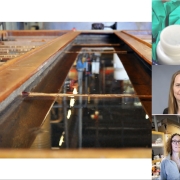
Overlay to medical dressing made from woody nanofibre networks. Nanofibre base gel in left-bottom corner. Images by courtesy of Linn Berglund. Collage by Anna Strom.

New Stride in Wound Healing Expected, as Researchers Add New Material for Medical Dressings

29 August, 2024/in News/by Anna Strom

On the back of successfully introducing sea kelp as a base material for hydrogels used in wound healing—and selling the rights to Norwegian firm Alginor ASA—Bio4Energy researchers are back with a deep-dive into making medical dressings for complex or chronic wounds. This time, the base material will be made from woody residues from trees.

Linn Berglund of Luleå University of Technology received a grant from national trade union Swedish Forest Industries, official voice of the sector, to place woody residues as the base material of choice in the treatment of wounds that require a certain level moisture to heal, but need to be rid of excess liquid formed at various stages of the healing process.

Based on a series of pre-studies, she will be using nanotechnology to make networks of wood fibres that hold just the right amount of moisture at the base of the dressing, which will have a transparent overlay.

“We are moving one step closer to the perfect wound dressing. We already have promising results with dressings that take up a lot of excess liquid in moist environments”.

“We are moving one step closer [to the perfect wound dressing]. We already have promising results with dressings that take up a lot of excess liquid in moist environments”, according to Berglund, researcher and long-standing member of Bio4Energy’s team of experts at nanotechnology.

“When it comes to burns for example, the liquid should be transported away, not closed in”, she added.

The efficacy of the nanofibre network, together with the transparent top part, should allow for the healing to be monitored without the need for frequent changes of the dressing.

“The transparency of the material creates unique possibilities”, Berglund told Bio4Energy Communications.

The project will run at least until the end of next year. By that time, the researchers expect to know more about the way in which the dressing materials react at various degrees of swelling due to liquid retention. We are talking about characterisation down to nano scale.

“We are going to use atomic force microscopy [coupled with] trials enabled by new equipment for rheology measurements”.

Atomic Force Microscopy is a very-high-resolution type of scanning probe technique, with resolutions in the order of fractions of a nanometre, according to Wikipedia. 

Other legs of the set up include life cycle assessment studies to check the environmental impacts; not only of the wound dressing at the end of life, but also of the production. Moreover expensive chemicals are used in the production. The researchers are going to look for ways to reduce the chemical input while obtaining similar results.

The grant is part of a Young Researchers Award, awarded in spring of this year, with funding from a Gunnar Sundblad Foundation.

For more information

Young Researchers Award (Page in Swedish)

Swedish Forest Industries

Contact

Linn Berglund, Bio4Energy Biopolymers and Biochemical Conversion Technologies

Related News

Breakthrough Innovation: Hydrogels from Norwegian Kelp to Be Commercialised – Bio4Energy

Related projects

Relation of wood structure and chemistry to nanocellulose extraction and properties – Bio4Energy
Utilising the natural composition of industrial bio-based residues for efficient separation of functional nanofibers – Bio4Energy

Tags: Bio4Energy, Bio4Energy Biopolymers and Biochemical Conversion Technologies, Bio4Energy Industrial Network, Luleå University of Technology, medical dressing, nanotechnology, woody residues, wound dressing
https://bio4energy.se/wp-content/uploads/2024/08/Nanofibre-dressing-overlay-gel_LB300824.gif 768 1366 Anna Strom https://bio4energy.se/wp-content/uploads/2022/08/Logo_stor_farg-300x74.png Anna Strom2024-08-29 16:52:272024-08-30 16:19:08New Stride in Wound Healing Expected, as Researchers Add New Material for Medical Dressings
You might also like
A so-called photobioreactor with microalgal content, in the laboratories of Christiane Funk and Martin Plöhn, both Bio4Energy. Photo by courtesy of Plöhn and Funk. Researchers to Map Composition of Green Algae, Pave Way for Biotechnology Breakthroughs
Trees play a vital role in maintaining the health of our planet and supporting human life in various ways. To use them as an economic resource, we advocate finding ways that will sustain both us and nature. Photo by AnnaStrom ©2024.©AnnaStrom Bio4Energy 2023: Full Steam Ahead in Education, Research, Forming Collaborations
The Hidden Conversation Between Trees and Nitrogen
Bio4Energy scientists Kristiina Oksman (left) and Linn Berglund are showing slivers of the brown kelp used as input material, at their research laboratory.LTU Breakthrough Innovation: Hydrogels from Norwegian Kelp to Be Commercialised
PhD students at a Bio4Energy event. Photo by ©AnnaStrom.©AnnaStrom 2022 Bio4Energy Annual Report Is Out
Senior lecturer and instrumentation expert Fredrik Forsberg, at Luleå University of Technology Geolab in 2022. Photo by courtesy of Fredrik Forsberg. Bio4Energy Partner LTU Part of ‘Largest Investment in Material Science in Sweden’
Stina Jansson (far right, centre) and team are sampling all post-incineration streams to gauge the presence and level of per- and polyfluorinated substances. Dåva combined heat and power plant at Umeå, Sweden. Photos by Ewa Weidemann, Anna Strom and UMU photographers.Bio4Energy Pioneering Work to Study ‘Forever’ Chemicals PFAS Targets Wastewater Treatment in Incineration Plants
From left: Nils Skoglund, Kajsa Sigfridsson Clauss and Konstantin Klementiev; hosting a workshop at Umeå, Sweden in November 2024.©AnnaStrom Breaking Down Benefits of Using Brilliant X-ray Light to Know Bio-based Materials: Workshop

Latest news

  • Bio4energy Advisory bord meeting (digital)
    Bio4Energy Advisory Board meeting – EU perspectives on the bioeconomy and bio-based resources23 February, 2026 - 11:38
  • The Hidden Conversation Between Trees and Nitrogen10 December, 2025 - 15:16
  • From Wood to Wonder – Turning wood into advanced materials15 November, 2025 - 19:09

VISITING ADDRESS

Umeå University Campus Map

ADDRESS

Bio4Energy

Umeå University

SE-90187 UMEÅ

Sweden

LOG IN

Link to: Bio4Energy 2023: Full Steam Ahead in Education, Research, Forming Collaborations Link to: Bio4Energy 2023: Full Steam Ahead in Education, Research, Forming Collaborations Bio4Energy 2023: Full Steam Ahead in Education, Research, Forming Collabora...Trees play a vital role in maintaining the health of our planet and supporting human life in various ways. To use them as an economic resource, we advocate finding ways that will sustain both us and nature. Photo by AnnaStrom ©2024.©AnnaStrom Link to: May We Tell You About Bio4Energy Advisory Board? Link to: May We Tell You About Bio4Energy Advisory Board? Bio4Energy Advisory Board with guests Alice Kempe, Karin Johnson, 3 September 2024.May We Tell You About Bio4Energy Advisory Board?
Scroll to top Scroll to top Scroll to top