Bio4Energy

  • Research
    • Platforms
    • Strategic Funds & Projects
    • Publications
  • Context
    • Global Challenges
    • Biomass Resources
    • Biorefineries
  • Education
    • Bio4Energy Graduate School
    • PhD Projects
    • Alumni
    • Undergraduate Education
  • Collaboration
    • Research Collaboration
    • Bio4Energy Advisory Board
  • About Us
    • Bio4Energy — A Strategic Research Environment
    • Contact
    • Open Positions
    • Download Materials
  • News & Events
    • Bio4Energy Calendar
  • Click to open the search input field Click to open the search input field Search
  • Menu Menu
Home1 / News2 / Researchers to Map Composition of Green Algae, Pave Way for Biotechnology...
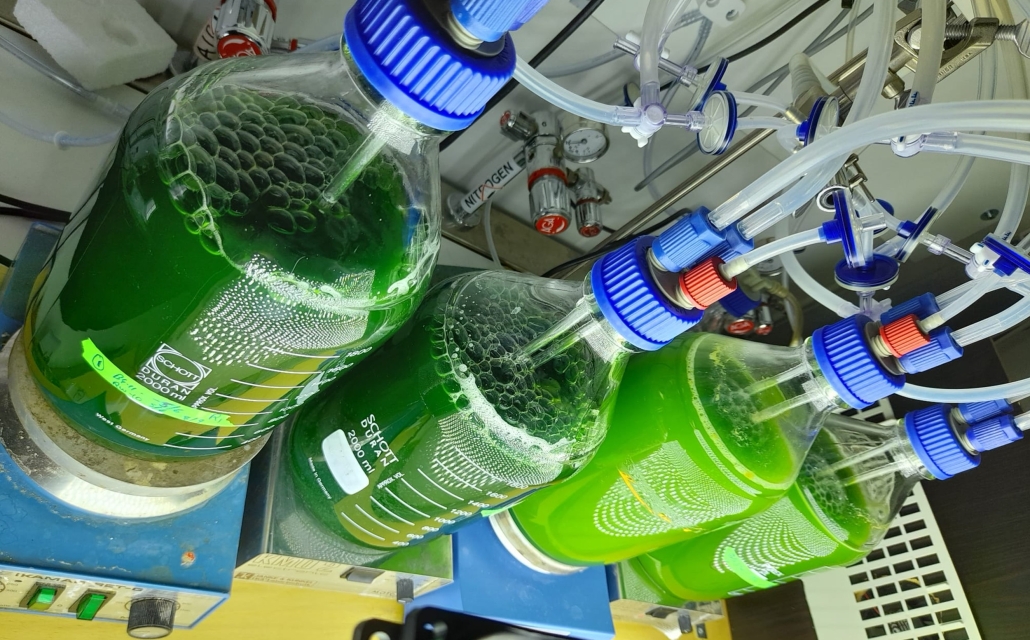
A so-called photobioreactor with microalgal content, in the laboratories of Christiane Funk and Martin Plöhn, both Bio4Energy. Photo by courtesy of Plöhn and Funk.

Researchers to Map Composition of Green Algae, Pave Way for Biotechnology Breakthroughs

4 November, 2024/in News/by Anna Strom

Bio4Energy’s research team dedicated to creating applications from green algae have won funds to investigate the composition of cell walls in microalgae. These are microscopic algae that are not visible to the unaided eye, used to produce algal biomass for use in biotechnology applications.

Christiane Funk and students at Umeå University, Sweden hope to develop much needed information on the mechanisms that govern buildup and breakdown of the cell wall in these Chlorophyta algae, with the aim of allowing researchers worldwide more easily to design biotechnology applications that are cost and energy efficient.

Last week, national funder Swedish Research Council – VR announced its decision to support a four-year project.

The researchers aim to find out which enzymes are involved in making the cell wall mouldable and the way in which this plasticity enables – or could enable – the green algae to cope with environmental stressors. They also aim to map the transport of carbon, which is known to fluctuate, inside the cell.

With this knowledge in hand, they want to look into ways to manipulate the cell wall for better outcomes in the design of biotechnology applications.

“This proposal aims to address a critical gap in research, by investigating the biosynthesis and modification of the cell wall of Chlorophyta microalgae. We will gain insights into the molecular mechanisms underlying the microalgal cell wall, its plasticity and perception of the environment”.

“Despite their promise as a sustainable feedstock for biotechnological applications, the use of microalgae has been hindered by high monetary and energy costs associated with the processing steps that follow cultivation, particularly the harvesting of algal biomass and extraction of valuable compounds”, Funk and colleagues wrote in their project application;

“This proposal aims to address this critical gap in research, by investigating the biosynthesis and modification of the cell wall of Chlorophyta microalgae. We will gain insights into the molecular mechanisms underlying the microalgal cell wall, its plasticity and perception of the environment”.

Over the last decade, Bio4Energy’s research teams studying microalgae have worked diligently to lay a foundation for production, scale up and demonstration of algal biomass for use in consumer products and as an agent in water purification in industrial facilities.

The two teams focus on green and blue-green microalgae, respectively. Francesco Gentili and colleagues, Swedish University of Agricultural Sciences, run development facilities in collaboration with regional energy utility Umeå Energi, at Dåva just off Umeå, in northern Sweden.

Project title: Not Just Another Brick in the Wall – Advancing Microalgal Biotechnology through Cell Wall Research

Project leader: Christiane Funk, Bio4Energy Biopolymers and Biochemical Conversion Technologies – Affiliation with Umeå University

Duration: 2025 – 2028

Related projects

Revitalising forest waste into microalgal and bacterial cellulose membranes with tailored properties for sustainable food packaging, Green Tech – Bio4Energy

Circular and sustainable production of bioplastics with the help of photosynthetic microorganisms – Proof of concept – Bio4Energy

Waste2Plastic – Production of bioplastic from algal biomass generated from wastewater – Bio4Energy

Related news

Microalgae that Thrive in Cold Climate Clean Wastewater, Give Biomass for Renewable Plastics – Bio4Energy

Sweden’s Bioeconomy Arena to Open by Early 2025: Bio4Energy Researchers Stopped by – Bio4Energy

Breakthrough Innovation: Hydrogels from Norwegian Kelp to Be Commercialised – Bio4Energy
Tags: algal biomass, Bio4Energy, Bio4Energy Biopolymers and Biochemical Conversion, Bio4Energy Environment and Nutrient Recycling, fundamental research, green algae, research grant, Swedish Research Council, Swedish University of Agricultural Sciences, Umeå Energi, Umeå University
https://bio4energy.se/wp-content/uploads/2024/11/DIY-Photobioreactor_Funk_Ploehn.jpg 1553 2500 Anna Strom https://bio4energy.se/wp-content/uploads/2022/08/Logo_stor_farg-300x74.png Anna Strom2024-11-04 16:35:302024-11-29 13:01:36Researchers to Map Composition of Green Algae, Pave Way for Biotechnology Breakthroughs
You might also like
Advanced students gathered at Umea, Sweden, for the course Wood Biology and Biotechnology. Photos by Anna Shevtsova and ©AnnaStrom.©AnnaStrom Training on Wood Biology, Biotechnology Fills Gap for Advanced Students of Biorefinery
Bio4Energy 2022 Bio4Energy Celebrates its 100th Thesis Defence by PhD Student
Cleaner cooking and sustainable bioenergy systems can strengthen energy security and improve health in sub-Saharan Africa
From left: Nils Skoglund, Kajsa Sigfridsson Clauss and Konstantin Klementiev; hosting a workshop at Umeå, Sweden in November 2024.©AnnaStrom Breaking Down Benefits of Using Brilliant X-ray Light to Know Bio-based Materials: Workshop
LACCASE lignin encoding in plants could be used to make them resilient to drought and strong winds. Photos by Stockholm University affiliates.Stockholm University/Edouard Pesquet Plants Adapt their Lignin Using Chemical ‘Encoding’ Enzymes, New Report Suggests
Naser Tavajohi shows a module for an artificial membrane, at one of his research laboratories at Umeå University, Sweden. Photo by Anna Strom ©2022.©AnnaStrom Young Researcher Wins Prize for Development of Sustainable Artificial Membranes
Biomass (left) must be turned into biocarbon (right) in a controlled process to be an alternative for use to fossil coal in the iron and steel industries. Kentaro Umeki is Bio4Energy's man on the job. Photos by courtesy of Kentaro Umeki, Luleå University of Technology.Courtesy Kentaro Umeki. Collage by Anna Strom Phase Out of Fossil Coal in Sweden’s Iron, Steel Industries on Cards


Carmen Cristescu and Dimitris Athanassiadis are coordinators for Bio4Energy's new training on the history of biorefining. Photo by Anna Strom ©2023.©AnnaStrom New Training: History of Biorefining in Nordic Countries

Latest news

  • Bio4energy Advisory bord meeting (digital)
    Bio4Energy Advisory Board meeting – EU perspectives on the bioeconomy and bio-based resources23 February, 2026 - 11:38
  • The Hidden Conversation Between Trees and Nitrogen10 December, 2025 - 15:16
  • From Wood to Wonder – Turning wood into advanced materials15 November, 2025 - 19:09

VISITING ADDRESS

Umeå University Campus Map

ADDRESS

Bio4Energy

Umeå University

SE-90187 UMEÅ

Sweden

LOG IN

Link to: Publication Link to: Publication Publication Link to: Bio4Energy Advisory Board meeting – EU perspectives on the bioeconomy and bio-based resources Link to: Bio4Energy Advisory Board meeting – EU perspectives on the bioeconomy and bio-based resources Bio4energy Advisory bord meeting (digital)Bio4Energy Advisory Board meeting – EU perspectives on the bioeconomy and...
Scroll to top Scroll to top Scroll to top