
 Bio4Energy
Pioneering Work to Study ‘Forever’ Chemicals PFAS Targets Wastewater Treatment in Incineration Plants
Backgrounder. Over the last decade, environmental chemists aiming to map and close the loop on toxic chemicals in the handling and incineration of household waste, or in combustion facilities in the bio-based sector, have increasingly turned their attention to per- and polyfluoroalkyls, PFAS.
Since the 1950s, this very large group of manmade chemicals has been used in consumer products to repel water and oil. Experts are increasingly referring to them as “forever” chemicals, because of their extreme persistence in environment, and which may also spread over wide areas through contact with water.
Even though PFAS are used worldwide in detergents, cosmetics, non-stick coatings and dirt or water-repellent textiles, their fate and impact at the end of life are largely unknown.
Academia and industry in long-standing collaboration
Environmental chemists, led by Bio4Energy’s first programme manager Stellan Marklund, were leaders in the field of isolating and assessing dioxins formed as a result of operating waste-to-energy plants.
Dioxins and dioxin-like substances, including PCBs, are persistent organic pollutants (POPs) regulated globally by the Stockholm Convention of the United Nations. POPs can travel long distances from the source of emission and bioaccumulate in food chains.
This long-standing collaboration with industry in northern Sweden, and notably with regional energy utility Umeå Energi continues with associate professor Stina Jansson of Umeå University. It draws on the knowledge obtained and infrastructure put in place to tackle the more recently seen risk of PFAS leaking to soils, air and water as a result of waste storage and incineration.
This long-standing collaboration with industry in northern Sweden, and notably with regional energy utility Umeå Energi continues with Marklund’s former student, associate professor Stina Jansson of Umeå University. It draws on the knowledge obtained and infrastructure put in place to tackle the more recently seen threat of PFAS leaking to soils, air and water as a result of waste storage and incineration.
“We do not know the fate of PFAS in waste incineration. It is a black box”, Jansson said.
Her team, however, has started tackling the problem from the ground up.
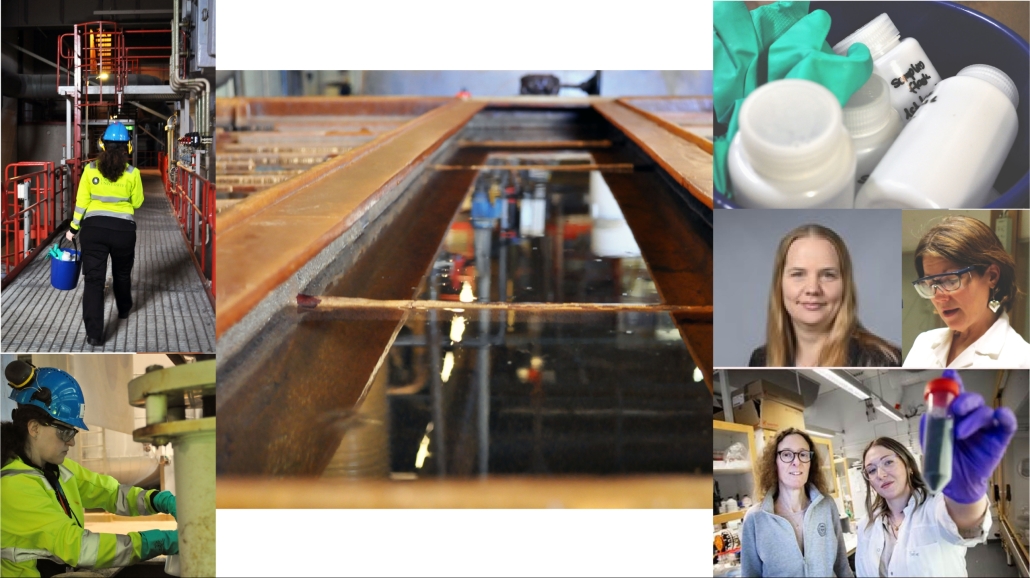
Samples taken throughout the regional combined heat and power plant at Dåva, collected by Sofie Björklund, Eva Weidemann and Alana Lansky, point to the presence of PFAS in all intra-plant waste or residual streams. In a recent scientific article, the team also shows that the common practice of supplementing household waste with digested sludge from industrial operations significantly increases the level of PFAS in flue gases, ash or process water from waste incineration.
The secret may be in the water
“We know that there are considerable amounts of PFAS in waste water sludge… and have located accumulations at the water purification stage. We see froth and even foaming in the process water”, according to Jansson.
People who go out in nature may recall seeing this type of froth or foam in shallow lake waters or, in certain countries, at the exit of waste water pipes, which could be a sign of PFAS pollution.
Thanks to the encompassing work to identify, charaterise and capture dioxins in similar contexts, the scientific researchers are able to draw parallels and make educated guesses about which types of technology can be used to rein in the lion’s share of PFAS compounds that remain onsite at the end of the incineration process.
“We are working together with other researchers to understand [how and what triggers] the breakdown of these compounds”, Jansson said.
At the Umeå cluster, the researchers are focusing on hydrothermal carbonisation. Scientists at the National Aeronautics and Space Administration of the United States of America, are targeting a method that involves using plasma for the breakdown.
“We may go into collaboration with them”, Jansson added.
Other techniques being tested elsewhere include membrane technology and ozone treatment.
“Our method of testing the process water is unique… This process water can be leachate of landfills, for example. Perhaps this will be where we can stop the pollution”, Jansson said.
New for July 2024: Press article, Helios Innovations takes the fight against eternal chemicals • PFAS – GAMINGDEPUTY
New for September 2024: News by Phys.org, Forever chemicals persist through waste incineration, researcher finds
Scientific article
Distribution of per- and polyfluoroalkyl substances (PFASs ) in a waste-to-energy plant: tracking PFASs in internal residual streams. In Environmental Science and Technology, ISSN 0013-936X, E-ISSN 1520-5851, Vol. 58, no 19, p. 8457-8463
Contact
Stina Jansson, Bio4Energy Environment and Nutrient Recycling
Related News
PhD Student Wins Prize for ‘Outstanding’ Work to Capture Micropollutants – Bio4Energy
Change of Leader at Bio4Energy Environment, Nutrient Recycling – Bio4Energy
Related Projects
 ©AnnaStrom
 Bio4Energy
 ©AnnaStrom
 ©AnnaStrom
 LTU
LTU






 ©AnnaStrom
 ©AnnaStrom