
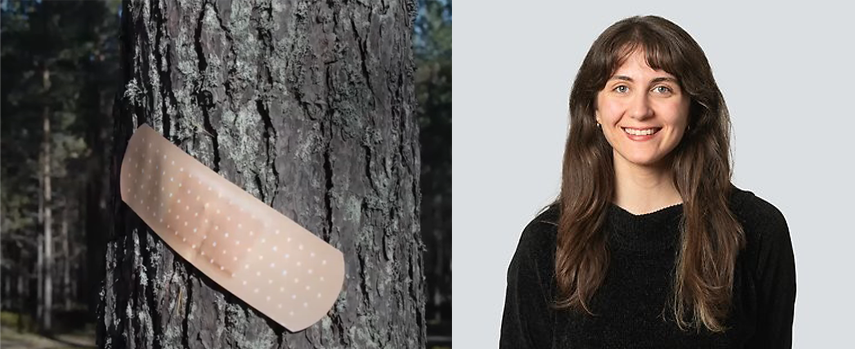
From Wood to Wonder – Turning wood into advanced materials
For centuries, we’ve known how to make paper from wood.
Who would have imagined that one day it could help heal wounds?
Science keeps pushing boundaries and makes the impossible possible.
Cellulose, in particular, is nature’s quiet masterpiece: a strong, fibrous network that gives trees their strength and shape. These structures work together, forming the tall forests that breathe life into our planet. Now imagine being able to gently rearrange that internal structure of wood and guide it into new forms. With a careful touch of chemistry, this transformation becomes possible. One of the most effective ways to achieve this is through a process called TEMPO oxidation, which allows scientists to open up the cellulose fibers and reveal the hidden layers within wood. Its structure separates into nanocellulose, threads thousands of times thinner than a human hair, yet remarkably strong. From these, new materials can be formed: light, transparent, and flexible sheets, known as nanocellulose films, that still carry the essence of their natural origin.
But to reach this stage, wood must first go through a long journey: stripped, pulped, bleached, and refined before it can be transformed into nanocellulose. PhD student Yagmur Bas asked a simple but daring question: What if we could skip all that?
“I wanted to see how far we could go using the wood in its natural, unprocessed form,” Yagmur explains. “Could it still develop into a nanocellulose network, without all the usual processing?”
To find out, she began working with wood particles from different species, exposing them to the same TEMPO-oxidation process normally used for refined pulp. She compared these raw particles with never-dried and commercial TEMPO-oxidized pulps, watching how each material changed as the fibers unfolded and reformed into delicate networks. Some woods opened more readily and carried more charge; others formed denser, tougher structures. These side-by-side experiments offered a rare glimpse into how both the origin of the tree and the way the material had been processed shaped the chemistry and the nature of the final film.
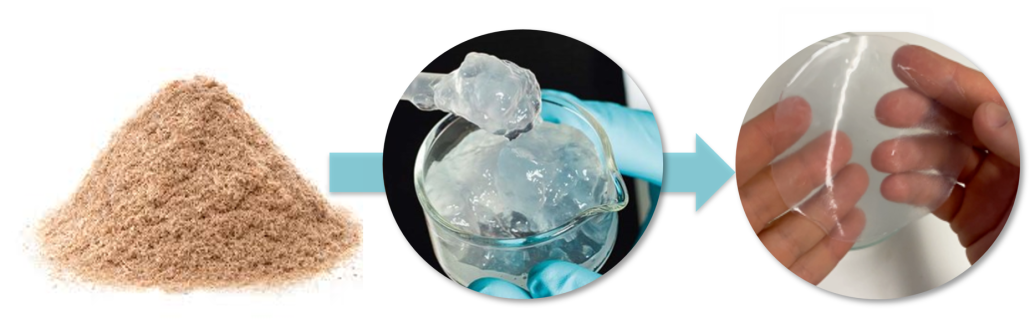
The result was a material with a character of its own. The nanocellulose networks formed from TEMPO-oxidized wood turned out to be remarkably stable and adaptable. They absorb in large amounts of liquid while staying intact, their fine structure holding together even when fully swollen. This balance between softness and strength made them ideal for for contact with living tissue: gentle to skin, yet mechanically reliable.
Working closely with her supervisor, Linn Berglund, Yagmur began shaping these films into materials that could serve real functions, particularly for wound healing. Together with biochemical collaborators, they looked for ways to integrate bioactive compounds, such as “healing peptides”, into the cellulose network, allowing the film not just to protect but to actively support recovery.
The transparency of the films added another dimension. Light could pass through the thin, wood-derived film, revealing what lay beneath, a property that would soon capture attention far beyond the laboratory.
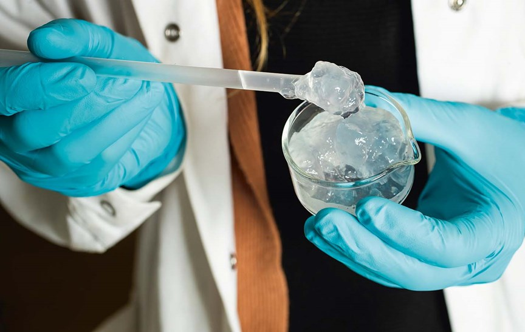
Foto: Per Bäckström
“As soon as they saw it, the nurses focused on the transparency,” recalls Linn Berglund. “Being able to check a wound without taking off the dressing is a clear clinical advantage.”
Beyond the biomedical field, the films also showed potential for electrochemical applications, demonstrating stability and ion transport properties relevant for energy storage systems.
What began as a materials study had quietly grown into something more, a collaboration that shaped both the material and the people behind it. For Yagmur Bas, it became a foundation to build on, and the next step of that journey will unfold at her upcoming public defense.
Yagmur Bas will publicly defend her doctoral thesis, From Wood to Advanced Materials: Multifunctional TEMPO-Oxidized Wood Nanofibril Networks as Wound Dressings and Energy Storage Device Separators at Luleå University of Technology, on 20 November 2025 at 10:00.